Friday, November 15, 2013

Indian Mars mission beats neighbours

OPINION: Last Tuesday the Indian space agency launched a mission to Mars. Its goal is to place a satellite into orbit around that planet.
The probe is currently in Earth orbit (although not quite high enough yet, thanks to a brief engine failure yesterday) with a planned insertion into a Mars transfer orbit on December 1. It should reach Mars in September next year.
This is India’s first interplanetary mission. It follows a successful mission to the Moon in 2008-2009.
Why Mars matters
Mars holds a special place in the human mind. In our imaginations we have populated it with intelligent creatures who built canals and pyramids and carved giant faces into the rock. We have had giant worms slither through its sands. We faked an invasion of Earth by Martians.
Enthusiasts amongst us have fantasised about “terraforming” Mars so that we can move there after we have made Earth uninhabitable as a result of our rapacious habits.
The more sober of us see Mars as the most likely site in our solar system for a second origin of life. Discovering even microbes there could revolutionise biology, challenge some religious beliefs and point to an answer to that great question “Are we alone?”.
More prosaically perhaps, “just” getting there can be used to demonstrate the technical expertise of a nation and showcase its industrial ability. Such a “technology demonstrator” is also the first step in developing more ambitious missions.
So the motives for exploring Mars are never likely to be simple. Maybe they don’t matter as long as the results are good. But a number of commentators have noted that if India’s mission is successful they will have stolen a march on Japan and China, in particular.
Japan tried to reach Mars with a launch in 1998 but failed, and China appears to be quickly ramping up its space program. The USA, USSR and Europe got to Mars long ago, first in 1965 with a flyby and then in 1971 with an orbiting mission.
Sniffing for methane
The Indian satellite has scientifically interesting capabilities. One is its ability to detect methane.
This isn’t the first craft to investigate methane. A group using the Planetary Fourier Spectrometer onboard the European Space Agency’s Mars Express spacecraft first reported methane in the planet’s atmosphere in 2004. In a report published in 2009 this appeared to be confirmed by ground-based observations using the Keck telescopes in Hawaii.
Methane is interesting because most of it in our atmosphere is produced by methanogenic Archaea (or microbes); in other words, it is a signal of life. So we might have detected life on Mars.
But like all science it is not so simple.
Methane also comes from volcanic sources. And the ground-based observations could have resulted from methane in our own atmosphere (despite great care in trying to exclude that possibility). More tellingly, the Curiosity rover now active on Mars sniffed and found no methane.
It would be premature to get excited about a detection of life. But a sniff by the Indian instrument could make a useful contribution.
A tiny package, crammed with science
Also included in the instrument package is a photometer that will measure the relative abundance of deuterium and hydrogen in the upper atmosphere. This will allow the amount of water loss to outer space to be estimated, thus revealing an important aspect of the history of water on the planet.
Given that all life as we know it requires liquid water this will be another datapoint in the search for life, as well as revealing more about the climate history of the planet.
A quadrapole mass spectrometer will examine other aspects of the composition of the Martian upper atmosphere.
A thermal infrared imaging spectrometer will measure the properties of the Martian surface, allowing for mapping of surface composition and mineralogy (much of which has already been done by previous missions), and a colour camera will provide images in the visual spectrum.
All this is packed into a cube 1.5 m to a side and powered by solar panels.
There is no doubt that over recent years India has staked a claim to be a serious participant in the exploration of space. More power to them! May they reach Mars, demonstrate their skills and make great discoveries.
Professor Malcolm Walter is director of the Australian Centre for Astrobiology at UNSW.
This article was originally published at The Conversation. Read the original article.

Thursday, November 14, 2013

New Evidence for a Martian Ocean

Scientists studying data from NASA's Mars Reconnaissance Orbiter have discovered new evidence that Mars may have once had a vast ocean on its surface. The research team spotted an ancient delta where a river might have emptied into an ocean so large that it covered much of the planet's northern hemisphere.
Delta-like features have been found on Mars before, but most of them appear to flow into craters or similar geological boundaries, and not into places where ocean-sized bodies of water would have been likely to exist. The newly identified delta was found on what would have been the coastline of Mars' ancient ocean, and geological evidence in the delta points toward the ocean's existence.
Mars' northern lowlands have previously been compared to ocean basins on Earth, and scientists have long suspected that this flat area of low elevation is the remnant of an ancient martian seabed. The recent study provides new support for that theory.
The study could also help astrobiologists understand past environments on Mars where surface water persisted for long periods of time. This is important in determining whether or not habitats on ancient Mars were capable of supporting life as we know it.
The study, "Deltaic deposits at Aeolis Dorsa: Sedimentary evidence for a standing body of water on the northern plains of Mars," was published in the July 12 issue of the Journal of Geophysical Research

Wednesday, November 13, 2013

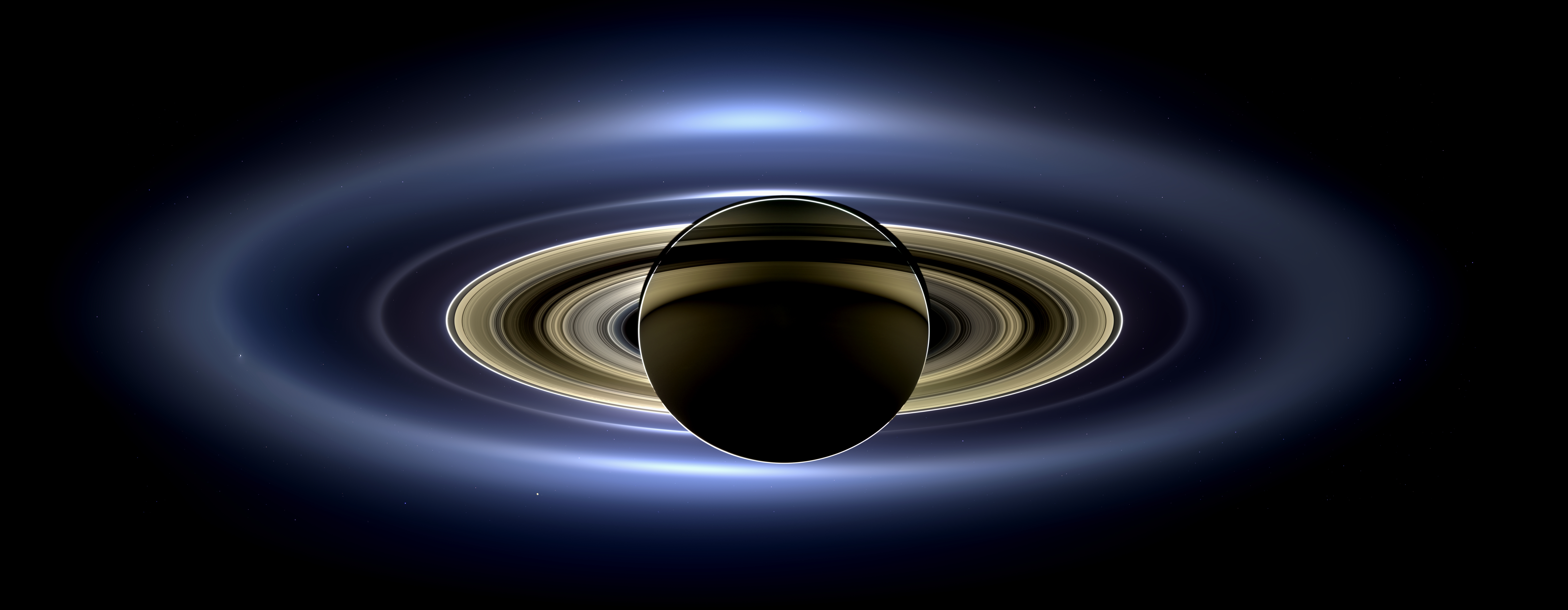
The Day the Earth Smiled ( credits: Jet Propulsion Laboratory )

Click here for poster version of PIA17172
Figure 1

Figure 2 for PIA17172Figure 3 for PIA17172
Figure 2Figure 3
On July 19, 2013, in an event celebrated the world over, NASA's Cassini spacecraft slipped into Saturn's shadow and turned to image the planet, seven of its moons, its inner rings -- and, in the background, our home planet, Earth.
With the sun's powerful and potentially damaging rays eclipsed by Saturn itself, Cassini's onboard cameras were able to take advantage of this unique viewing geometry. They acquired a panoramic mosaic of the Saturn system that allows scientists to see details in the rings and throughout the system as they are backlit by the sun. This mosaic is special as it marks the third time our home planet was imaged from the outer solar system; the second time it was imaged by Cassini from Saturn's orbit; and the first time ever that inhabitants of Earth were made aware in advance that their photo would be taken from such a great distance.
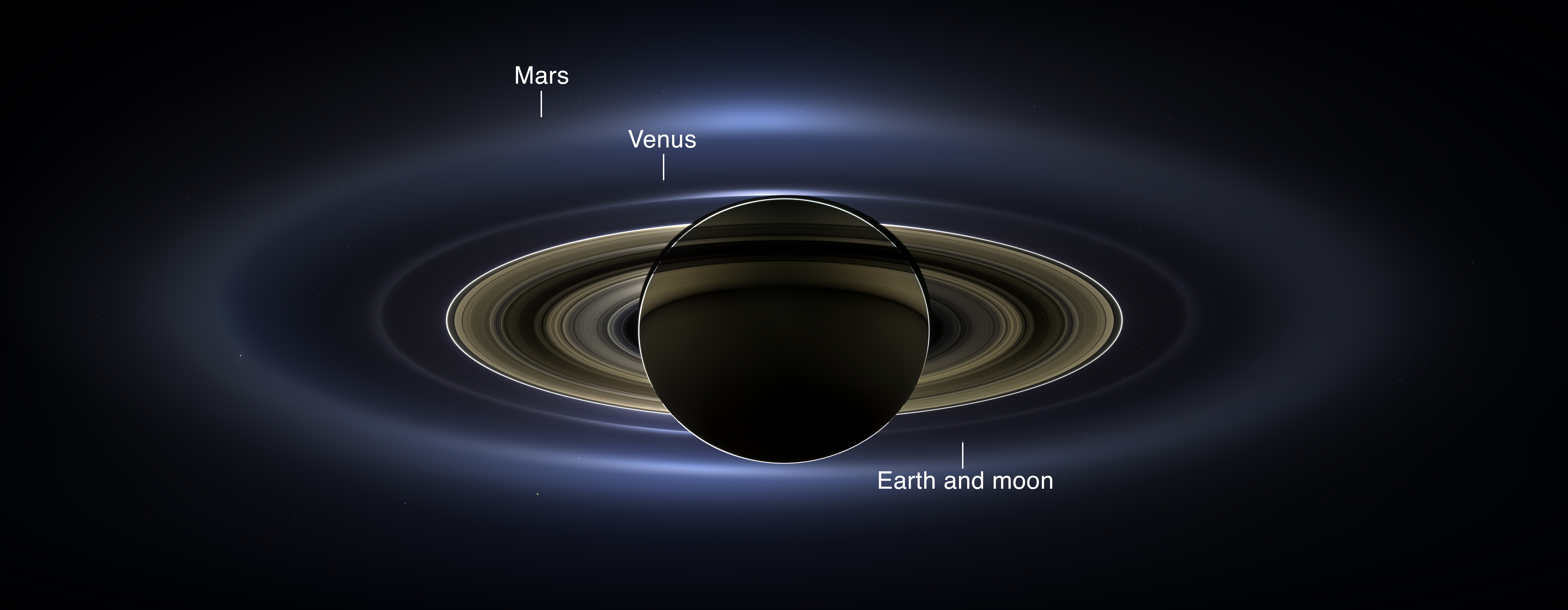
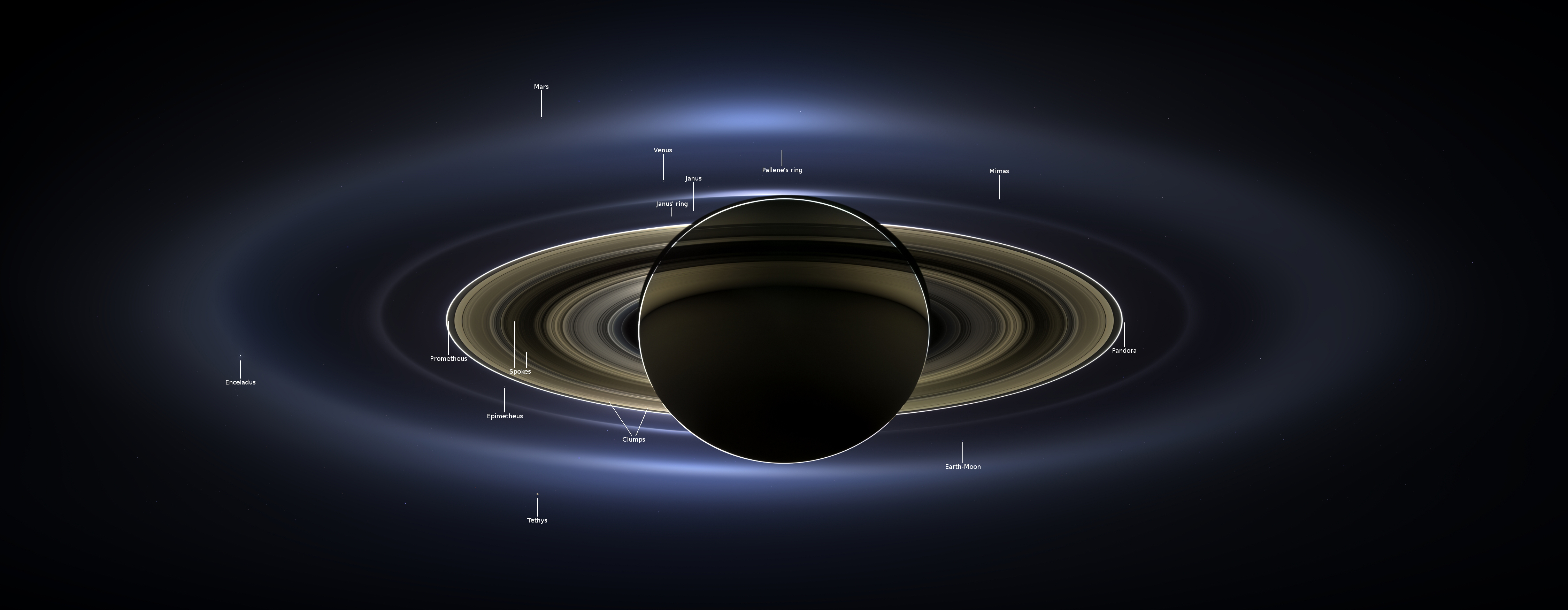
With both Cassini's wide-angle and narrow-angle cameras aimed at Saturn, Cassini was able to capture 323 images in just over four hours. This final mosaic uses 141 of those wide-angle images. Images taken using the red, green and blue spectral filters of the wide-angle camera were combined and mosaicked together to create this natural-color view. A brightened version with contrast and color enhanced (Figure 1), a version with just the planets annotated (Figure 2), and an annotated version (Figure 3) are shown above.
This image spans about 404,880 miles (651,591 kilometers) across.
The outermost ring shown here is Saturn's E ring, the core of which is situated about 149,000 miles (240,000 kilometers) from Saturn. The geysers erupting from the south polar terrain of the moon Enceladus supply the fine icy particles that comprise the E ring; diffraction by sunlight gives the ring its blue color. Enceladus (313 miles, or 504 kilometers, across) and the extended plume formed by its jets are visible, embedded in the E ring on the left side of the mosaic.
At the 12 o'clock position and a bit inward from the E ring lies the barely discernible ring created by the tiny, Cassini-discovered moon, Pallene (3 miles, or 4 kilometers, across). (For more on structures like Pallene's ring, seePIA08328). The next narrow and easily seen ring inward is the G ring. Interior to the G ring, near the 11 o'clock position, one can barely see the more diffuse ring created by the co-orbital moons, Janus (111 miles, or 179 kilometers, across) and Epimetheus (70 miles, or 113 kilometers, across). Farther inward, we see the very bright F ring closely encircling the main rings of Saturn.
Following the outermost E ring counter-clockwise from Enceladus, the moon Tethys (662 miles, or 1,066 kilometers, across) appears as a large yellow orb just outside of the E ring. Tethys is positioned on the illuminated side of Saturn; its icy surface is shining brightly from yellow sunlight reflected by Saturn. Continuing to about the 2 o'clock position is a dark pixel just outside of the G ring; this dark pixel is Saturn's Death Star moon, Mimas (246 miles, or 396 kilometers, across). Mimas appears, upon close inspection, as a very thin crescent because Cassini is looking mostly at its non-illuminated face.
The moons Prometheus, Pandora, Janus and Epimetheus are also visible in the mosaic near Saturn's bright narrow F ring. Prometheus (53 miles, or 86 kilometers, across) is visible as a faint black dot just inside the F ring and at the 9 o'clock position. On the opposite side of the rings, just outside the F ring, Pandora (50 miles, or 81 kilometers, across) can be seen as a bright white dot. Pandora and Prometheus are shepherd moons and gravitational interactions between the ring and the moons keep the F ring narrowly confined. At the 11 o'clock position in between the F ring and the G ring, Janus (111 miles, or 179 kilometers, across) appears as a faint black dot. Janus and Prometheus are dark for the same reason Mimas is mostly dark: we are looking at their non-illuminated sides in this mosaic. Midway between the F ring and the G ring, at about the 8 o'clock position, is a single bright pixel, Epimetheus. Looking more closely at Enceladus, Mimas and Tethys, especially in the brightened version of the mosaic, one can see these moons casting shadows through the E ring like a telephone pole might cast a shadow through a fog.
In the non-brightened version of the mosaic, one can see bright clumps of ring material orbiting within the Encke gap near the outer edge of the main rings and immediately to the lower left of the globe of Saturn. Also, in the dark B ring within the main rings, at the 9 o'clock position, one can see the faint outlines of two spoke features, first sighted by NASA's Voyager spacecraft in the early 1980s and extensively studied by Cassini.
Finally, in the lower right of the mosaic, in between the bright blue E ring and the faint but defined G ring, is the pale blue dot of our planet, Earth. Look closely and you can see the moon protruding from the Earth's lower right. (For a higher resolution view of the Earth and moon taken during this campaign, see PIA14949.) Earth's twin, Venus, appears as a bright white dot in the upper left quadrant of the mosaic, also between the G and E rings. Mars also appears as a faint red dot embedded in the outer edge of the E ring, above and to the left of Venus.
For ease of visibility, Earth, Venus, Mars, Enceladus, Epimetheus and Pandora were all brightened by a factor of eight and a half relative to Saturn. Tethys was brightened by a factor of four. In total, 809 background stars are visible and were brightened by a factor ranging from six, for the brightest stars, to 16, for the faintest. The faint outer rings (from the G ring to the E ring) were also brightened relative to the already bright main rings by factors ranging from two to eight, with the lower-phase-angle (and therefore fainter) regions of these rings brightened the most. The brightened version of the mosaic was further brightened and contrast-enhanced all over to accommodate print applications and a wide range of computer-screen viewing conditions.
Some ring features -- such as full rings traced out by tiny moons -- do not appear in this version of the mosaic because they require extreme computer enhancement, which would adversely affect the rest of the mosaic. This version was processed for balance and beauty.
This view looks toward the unlit side of the rings from about 17 degrees below the ring plane. Cassini was approximately 746,000 miles (1.2 million kilometers) from Saturn when the images in this mosaic were taken. Image scale on Saturn is about 45 miles (72 kilometers) per pixel.
This mosaic was made from pictures taken over a span of more than four hours while the planets, moons and stars were all moving relative to Cassini. Thus, due to spacecraft motion, these objects in the locations shown here were not in these specific places over the entire duration of the imaging campaign. Note also that Venus appears far from Earth, as does Mars, because they were on the opposite side of the sun from Earth.
The Cassini-Huygens mission is a cooperative project of NASA, the European Space Agency and the Italian Space Agency. NASA's Jet Propulsion Laboratory, a division of the California Institute of Technology in Pasadena, manages the mission for NASA's Science Mission Directorate, Washington, D.C. The Cassini orbiter and its two onboard cameras were designed, developed and assembled at JPL. The imaging operations center is based at the Space Science Institute in Boulder, Colo.
For more information about the Cassini-Huygens mission visit http://www.nasa.gov/cassini andhttp://saturn.jpl.nasa.gov.

Thursday, October 31, 2013

First Earth-Sized Rocky Exoplanet Discovered

Artist's impression of the planet Kepler-78b and its host star. Art by Karen Teramura (UHIfA)

A team of astronomers has found the first Earth-sized planet outside the solar system that has a rocky composition like that of Earth. This exoplanet, known as Kepler-78b, orbits its star very closely every 8.5 hours, making it much too hot to support life. The results are being published in the journal Nature. This Earth-sized planet was discovered using data from NASA’s Kepler Space Telescope, and confirmed and characterized with the W. M. Keck Observatory. Every 8.5 hours the planet passes in front of its host star, blocking a small fraction of the starlight. These telltale dimmings were picked up by researchers analyzing the Kepler data.

The team led by Dr. Andrew Howard (Institute for Astronomy, University of Hawaii at Manoa) then measured the mass of the planet with the Keck Observatory on Mauna Kea, in Hawaii. Using the ten-meter Keck I telescope fitted with the HIRES instrument, the team employed the radial velocity method to measure how much an orbiting planet causes its star to wobble, to determine the planet’s mass. This is another excellent example of the synergy between the Kepler survey, which has identified more than 3,000 potential exoplanet candidates, and Keck Observatory, which plays a leading role in conducting precise Doppler measurements of the exoplanet candidates.

A handful of planets the size or mass of Earth have been discovered recently. This is the first one with both quantities measured. “When you have both the size and the mass of an object, you can calculate its density, and thereby determine what it is made of,” explained Howard.

This illustration compares Earth with the newly confirmed scorched world of Kepler-78b. Kepler-78b is about 20 percent larger than Earth and is 70% more massive. Kepler-78b whizzes around its host star every 8.5 hours, making it a blazing inferno. Credit: David A. Aguilar (CfA)

With a radius about 1.2 times that of Earth and a mass equal to about 1.7 times Earth’s, Kepler-78b has a density that is the same as Earth’s, suggesting that it also made primarily of rock and iron. Its star is slightly smaller and less massive than the sun and is located about 400 light-years from Earth in the constellation Cygnus. 

Kepler-78b is a member of a new class of “ultrashort period” planets recently identified by the Kepler spacecraft. These newfound worlds all orbit their stars with orbital periods of less than 12 hours. They’re also small, about one-to-two times the size of Earth. Kepler-78b is the first planet in this new class to have its mass measured. It is a mystery how these planets formed and made it so close to their host stars (only 1 percent of the Earth-sun separation in the case of Kepler-78b).

An artist's conception of Kepler-78b orbiting its parent star once every 8.5 hours. Credit: David A. Aguilar (CfA)

In a rather unique arrangement, a companion study led by Dr. Francesco Pepe (University of Geneva, Switzerland) that used the same Kepler data but independent radial velocity observations is being published in the same issue.

The two studies found very similar results. “The gold standard in science is having your findings reproduced by other researchers,” explained Howard. “In this case, we did not have to wait for this to happen.”


The other members of Howard’s team are Roberto Sanchis-Ojeda (MIT), who analyzed the transit data taken by the Kepler spacecraft to find the planet and calculate its size, Dr. Geoffrey Marcy (University of California, Berkeley), Dr. John Johnson (Harvard), Dr. Debra Fischer (Yale), Benjamin Fulton and Evan Sinukoff (UHM graduate students), and Dr. Jonathan Fortney (University of California, Santa Cruz).

Wednesday, October 30, 2013

HD 21997: Challenge to Planet Formation Theories

HD 21997 is a star in the southern constellation Fornax (the Furnace) that is yielding some surprising data about how planetary systems form. About 235 light years from Earth, the star is 1.8 times the mass of the Sun and is thought to be about thirty million years old. Observations by an international team using ESA’s Herschel Space Observatory and the Atacama Large Millimeter/sub-millimeter Array (ALMA) in Chile show a ring of material around the star that contains not only a good deal of gas but also the dust produced by the collision of planetesimals.
PR_2013_11_1gr
Image: ALMA images of the disk around HD 21997. The left image shows the emission of cold dust grains, situated in a ring around the central star. The middle image displays the emission from carbon monoxide, and shows that gas can also be found closer to the star than dust. The right image depicts the velocity of the gas. The red-colored parts of the disk move away from us, while the blue-colored parts move towards us, indicating that the gas is rotating/orbiting around the central star. Credit: Á. Kóspál (ESA) and A. Moór (Konkoly Observatory).
This is an unusual finding because our models of planet formation predict that the primordial gas should be completely out of a young system after no more than ten million years, pulled into the star itself, or aiding in the formation of gas giant planets, with the balance simply dissipating because of intense radiation from the young star. But the disk around HD 21997 is obviously a hybrid, one that links the early and late phases of disk evolution. Moreover, the dust ring and the gas ring do not coincide. Ágnes Kóspál (ESA) sees this as a clue to how the two disks formed:
“The gas ring starts closer to the central star than the dust. If the dust and the gas had been produced by the same physical mechanism, namely by the erosion of planetesimals, we would have expected them to be at the same location. This is clearly not the case in the inner disk.”
The amount of gas is striking. The team’s data show that the total gas mass is somewhere between thirty and sixty times the mass of the Earth, an indication that the gas disk really is primordial material, as the amount of gas freed by collisions between planetesimals would be insufficient to explain this quantity. What’s ahead is a search for more systems like HD 21997 for further information about how our models of planet formation may need to be revised.
This is not the first time we’ve found indications of hybrid disks. In fact, disks around β Pictoris, HD 32297, 49 Ceti, HD 172555, and HD 32297 are also known to contain small amounts of gas, a finding that has energized debate about whether the gas was produced by planetesimal collisions or was leftover material from the primordial disk. HD 21997 takes the debate to another level, because the amount of gas and the displacement of the two disks are strong indicators that the gas here is primordial, with all that implies about the need to adjust our models.
atacama
Image: Antennas of the Atacama Large Millimeter/submillimeter Array (ALMA), a compound telescope on the Chajnantor Plateau in the Chilean Andes. The final ALMA configuration has 66 antennas acting like a single telescope. Signals from this array made it possible to spatially resolve the emission of both the dust grains and the gas molecules. Credit: ESO/C. Malin.
The two papers on this work are Kóspál et al., “ALMA observations of the molecular gas in the debris disk of the 30 Myr old star HD 21997,” Astrophysical Journal Volume 776, Issue 2 (2013 – abstract) and Moór et al., “ALMA continuum observations of a 30 Myr old gaseous debris disk around HD 21997,” Astrophysical Journal Letters Volume 777, Issue 2 (2013 – abstract). 
tzf_img_post

Paleontologist Thinks He Found the Holy Grail of Science!

9 hours ago by John Davis
Meteorite bombardment left large craters that contained water and chemical building blocks for life,
which ultimately led to the first organisms.
It has baffled humans for millennia: how did life begin on planet Earth? Now, new research from a Texas Tech University paleontologist suggests it may have rained from the skies and started in the bowels of hell.
Sankar Chatterjee, Horn Professor of Geosciences and curator of paleontology at the Museum of Texas Tech University believes he has found the answer by connecting theories on chemical evolution with evidence related to our planet's early geology.
"This is bigger than finding any dinosaur," Chatterjee said. "This is what we've all searched for – the Holy Grail of science."
Thanks to regular and heavy comet and meteorite bombardment of Earth's surface during its formative years 4 billion years ago, the large craters left behind not only contained water and the basic chemical building blocks for life, but also became the perfect crucible to concentrate and cook these chemicals to create the first simple organisms. He will present his findings Oct. 30 during the 125th Anniversary Annual Meeting of the Geological Society of America in Denver. As well as discovering how ancient animals flew, Chatterjee discovered the Shiva Meteorite Crater, which was created by a 25-mile-wide meteorite that struck off the coast of India. This research concluded this giant meteorite wreaked havoc simultaneously with the Chicxulub meteorite strike near Mexico, finishing the dinosaurs 65 million years ago.
Ironically, Chatterjee's latest research suggests meteorites can be givers of life as well as takers. He said that
meteor and comet strikes likely brought the ingredients and created the right conditions for life on our planet. By studying three sites containing the world's oldest fossils, he believes he knows how the first single-celled
organisms formed in hydrothermal crater basins. Enlarge Crater basin may have been the crucible of life.
"When the Earth formed some 4.5 billion years ago, it was a sterile planet inhospitable to living organisms,"
Chatterjee said. "It was a seething cauldron of erupting volcanoes, raining meteors and hot, noxious gasses. One billion years later, it was a placid, watery planet teeming with microbial life – the ancestors to all living things."

"For may years, the debate on the origins of life centered on the chemical evolution of living cells from organic molecules by natural processes. Chatterjee said life began in four steps of increasing complexity – cosmic, geological, chemical and biological.

Most researchers believe that Life originated in deep-sea hydrothermal vents. About 4 billion years
ago, Earth was a watery planet; ocean stretched from pole to pole; any life synthesis would be
diluted. It needed a protected basin.
In the cosmic stage, a still-forming Earth and our solar system took a daily pounding from rocky asteroids and icy comets between 4.1 to 3.8 billion years ago. Plate tectonics, wind and water have hidden evidence of this early onslaught on our planet, but ancient craters on the surfaces of Mars, Venus, Mercury and our moon show just how heavy the meteorite showers once were.
Larger meteorites that created impact basins of about 350 miles in diameter inadvertently became the perfect
crucibles, he said. These meteorites also punched through the Earth's crust, creating volcanically driven
geothermal vents. Also, they brought the basic building blocks of life that could be concentrated and polymerized in the crater basins.

Hierarchical Origin of Life: Historical Contingency Parsimony principle chooses the simplest
explanation for the origin of life.
After studying the environments of the oldest fossil-containing rocks on Earth in Greenland, Australia and South Africa, Chatterjee said these could be remnants of ancient craters and may be the very spots where life began in deep, dark and hot environments.
Because of Earth's perfect proximity to the sun, the comets that crashed here melted into water and filled these basins with water and more ingredients. This gave rise to the geological stage. As these basins filled, geothermal venting heated the water and created convection, causing the water to move constantly and create a thick primordial soup.
"The geological stage provides special dark, hot, and isolated environments of the crater basins with the
hydrothermal vent systems that served as incubators for life," he said. "Segregation and concentration of organic molecules by convective currents took place here, something like the kinds we find on the ocean floor, but still very different. It was a bizarre and isolated world that would seem like a vision of hell with the foul smells of hydrogen sulfide, methane, nitric oxide and steam that provided life-sustaining energy."
Then began the chemical stage, Chatterjee said. The heat churning the water inside the craters mixed chemicals together and caused simple compounds to grow into larger, more complex ones.

Crater Basin with Hydrothermal Vent System Meteorites brought biomolecules of cell membrane.
Most likely, pores and crevices on the crater basins acted as scaffolds for concentrations of simple RNA and
protein molecules, he said. Unlike a popular theory that believes RNA came first and proteins followed,
Chatterjee believes RNA and proteins emerged simultaneously and were encapsulated and protected from the environment.
"The dual origin of the 'RNA/protein' world is more plausible in the vent environments than the popular 'RNA
world,'" he said. "RNA molecules are very unstable. In vent environments, they would decompose quickly.
Some catalysts, such as simple proteins, were necessary for primitive RNA to replicate and metabolize. On theother hand, amino acids, from which proteins are made, are easier to make than RNA components."
The question remains how loose RNA and protein material floating in this soup protected itself in a membrane. Chatterjee believes University of California professor David Deamer's hypothesis that membranous material existed in the primordial soup. Deamer isolated fatty acid vesicles from the Murchison meteorite that fell in 1969 in Australia. The cosmic fatty bubbles extracted from the meteorite mimic cell membranes.
"Meteorites brought this fatty lipid material to early Earth," Chatterjee said. "This fatty lipid material floated on top of the water surface of crater basins but moved to the bottom by convection currents. At some point in this process during the course of millions of years, this fatty membrane could have encapsulated simple RNA and proteins together like a soap bubble. The RNA and protein molecules begin interacting and communicating. Eventually RNA gave way to DNA – a much more stable compound – and with the development of the genetic code, the first cells divided."
The final stage – the biological stage – represents the origin of replicating cells as they began to store, process and transmit genetic information to their daughter cells, Chatterjee said. Infinite combinations took place, and countless numbers must have failed to function before the secret of replication was broken and the proper selection occurred.
"These self-sustaining first cells were capable of Darwinian evolution," he said. "The emergence of the first cells on the early Earth was the culmination of a long history of prior chemical, geological and cosmic processes."
Chatterjee also believes that modern RNA-viruses and protein-rich prions that cause deadly diseases probably represent the evolutionary legacy of primitive RNA and protein molecules. They may be the oldest cellular particles that predated the first cellular life. Once cellular life evolved, RNA-viruses and prions became redundant, but survived as parasites on the living cells.
The problem with theories on the origins of life is that they don't propose any experiments that lead to the
emergence of cells, Chatterjee said. However, he suggested an experiment to recreate the ancient prebiotic
world and support or refute his theory.
"If future experiments with membrane-bound RNA viruses and prions result in the creation of a synthetic
protocell, it may reflect the plausible pathways for the emergence of life on early Earth," he said.

Explore further: New findings challenge assumptions about origins of life
More information: community.geosociety.org/2013AnnualMeeting/Home

Sunday, October 27, 2013

Astronomy and Space News - Astro Watch: Carbon Worlds May be Waterless, Finds NASA Study

This artist's concept illustrates the fate of two different planets: the one on the left is similar to Earth, made up largely of silicate-based rocks with oceans coating its surface. Image Credit: NASA/JPL-Caltech

Planets rich in carbon, including so-called diamond planets, may lack oceans, according to NASA-funded theoretical research. Our sun is a carbon-poor star, and as result, our planet Earth is made up largely of silicates, not carbon. Stars with much more carbon than the sun, on the other hand, are predicted to make planets chock full of carbon, and perhaps even layers of diamond. By modeling the ingredients in these carbon-based planetary systems, the scientists determined they lack icy water reservoirs thought to supply planets with oceans.

"The building blocks that went into making our oceans are the icy asteroids and comets," said Torrence Johnson of NASA's Jet Propulsion Laboratory in Pasadena, Calif, who presented the results Oct. 7 at the American Astronomical Society Division of Planetary Sciences meeting in Denver. Johnson, a team member of several NASA planetary missions, including Galileo, Voyager and Cassini, has spent decades studying the planets in our own solar system.

"If we keep track of these building blocks, we find that planets around carbon-rich stars come up dry," he said.

Johnson and his colleagues say the extra carbon in developing star systems would snag the oxygen, preventing it from forming water.

"It's ironic that if carbon, the main element of life, becomes too abundant, it will steal away the oxygen that would have made water, the solvent essential to life as we know it," said Jonathan Lunine of Cornell University, Ithaca, N.Y., a collaborator on the research.

One of the big questions in the study of planets beyond our solar system, called exoplanets, is whether or not they are habitable. Researchers identify such planets by first looking for those that are situated within the "habitable zone" around their parent stars, which is where temperatures are warm enough for water to pool on the surface. NASA's Kepler mission has found several planets within this zone, and researchers continue to scrutinize the Kepler data for candidates as small as Earth.

But even if a planet is found in this so-called "Goldilocks" zone, where oceans could, in theory, abound, is there actually enough water available to wet the surface? Johnson and his team addressed this question with planetary models based on measurements of our sun's carbon-to-oxygen ratio. Our sun, like other stars, inherited a soup of elements from the Big Bang and from previous generations of stars, including hydrogen, helium, nitrogen, silicon, carbon and oxygen.

"Our universe has its own top 10 list of elements," said Johnson, referring to the 10 most abundant elements in our universe.

These models accurately predict how much water was locked up in the form of ice early in the history of our solar system, billions of years ago, before making its way to Earth. Comets and/or the parent bodies of asteroids are thought to have been the main water suppliers, though researchers still debate their roles. Either way, the objects are said to have begun their journey from far beyond Earth, past a boundary called the "snow line," before impacting Earth and depositing water deep in the planet and on its surface.

When the researchers applied the planetary models to the carbon-rich stars, the water disappeared. "There's no snow beyond the snow line," said Johnson.

"All rocky planets aren't created equal," said Lunine. "So-called diamond planets the size of Earth, if they exist, will look totally alien to us: lifeless, ocean-less desert worlds."


The computer model results supporting these conclusions were published in the Astrophysical Journal last year (http://arxiv.org/abs/1208.3289). The implications for habitability in these systems were the focus of the Division of Planetary Sciences meeting.